
Spring Hill City Directories: Local Collections
No verified, continuous run of printed Spring Hill volumes was located. That makes the known holdings more useful as a set of research routes than as a promise of a complete shelf. The secondary lead for a 1994 Columbia, Mt. Pleasant and Spring Hill volume has not been matched to a publisher or public scan. Williamson Special Collections confirms that it holds this material, but its exact years and any reverse-directory holdings must be requested from staff. For older names, the county archive, state microfilm, newspapers, and family-history collections offer dated evidence that can sit beside a directory lead.
| Collection | Years | Where Held | Access |
|---|---|---|---|
| Tri-city directory discovery lead | 1994 | Secondary genealogy reference to Historic Map Works/MyHeritage | Publisher and scan unverified |
| Williamson reference volumes | Exact runs not listed | Williamson Special Collections, Franklin | In-person research room, no checkout |
| Williamson Archives indexes | Deed Books 1786, 1792-1963, 1977; each group differs | Williamson Archives index and reading room | Free reference search; book, file, or microfilm follow-up |
| Maury historical microfilm | Direct/reverse deeds 1807-1905; other series vary | Tennessee State Library and Archives and participating libraries | Microfilm and county-record route |
| Maury and Spring Hill newspapers | Scattered 1810s; more complete from 1899 | TSLA, library databases, and county resources | Database or microfilm, title and date confirmed first |
Each row has a different evidentiary weight. A library entry is a useful snapshot. An archive index may only identify a book, reel, or loose file. A recorded deed or inspected original is a separate step. Note: Retain the volume title, page or reel reference, county, date span, and access date with every Spring Hill directory lead.
Spring Hill Records Routes by County
Spring Hill is a municipality in both Maury and Williamson Counties, not a county seat. That geography shapes historical research. Columbia is the Maury County seat and Franklin is the Williamson County seat, so a name, parcel, or deed hit needs a county label before it can be connected to an address. A Spring Hill postal address may also use 37179 and the postal city Thompson's Station. Postal city, city limits, and county are three different fields.
For a Williamson-side historic name, begin with the Archives index and its record-group choices. For a Maury-side name, the TSLA fact sheet identifies deed, marriage, will, tax, minute, and WPA materials. Do not treat either route as a citywide directory. They are county record systems that can corroborate a household, ownership, or date after the proper county is known.
Records geography. A Spring Hill name can belong to Maury County, Williamson County, a postal-only match, or a historical record from before current city limits. Keep those labels separate.
Spring Hill City Directory Leads Online
The Williamson Archives search is free and supports Name, Keyword, and Field tabs. A name search accepts last and first name with one or more record groups. Keyword search offers all-terms or any-term choices, and field search narrows a selected group. A result can point to microfilm, a bound book, or a loose file, so an index hit does not mean the underlying page is digitized or immediately available.
Digital Tennessee's Williamson collection provides browse and search entry to county originals, books, microfilm, and scans. It did not yield a digitized Spring Hill city-directory scan in the reviewed sources. Use it to discover a record reference, then preserve the collection name and reference before requesting a copy or checking the reading room.
Here is the Digital Tennessee collection entry used as a starting point for a Spring Hill archive search.
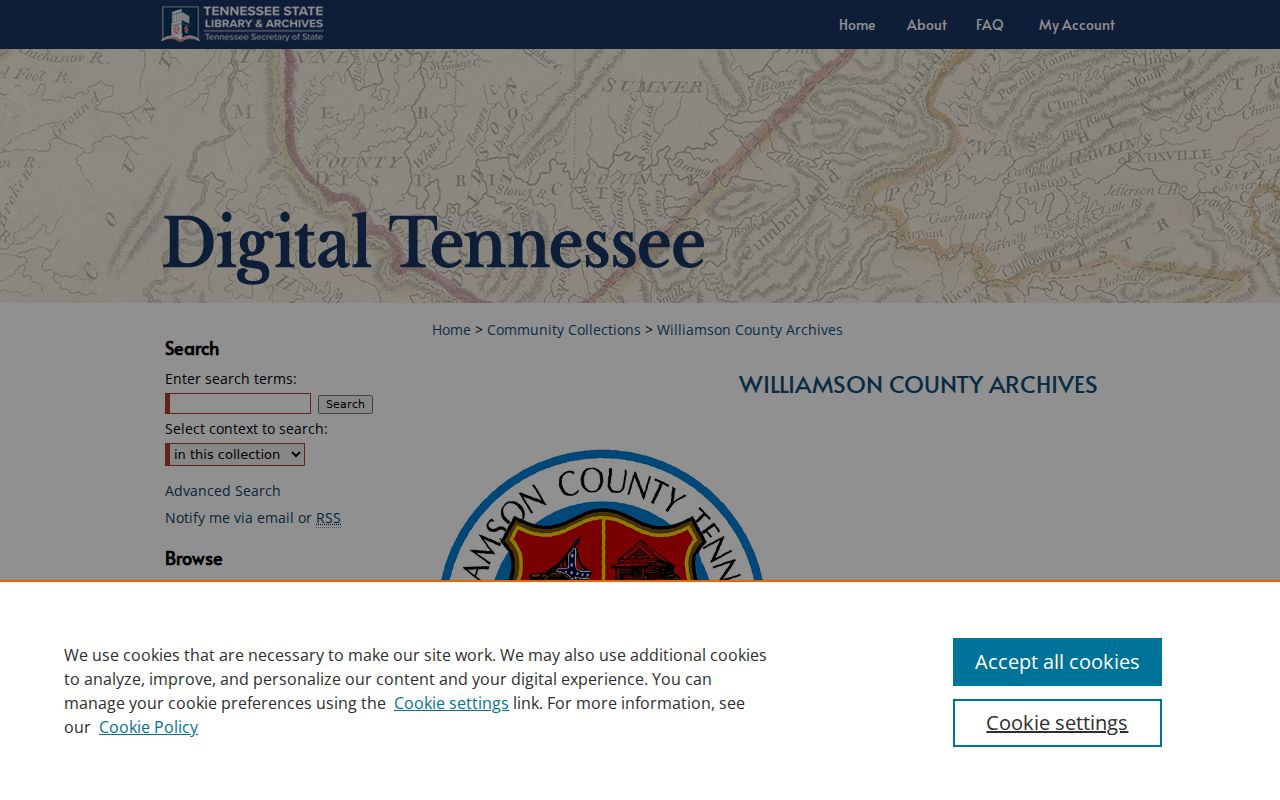
The image shows a collection gateway, not a verified directory volume. It is a useful reminder to browse the actual collection and read the item description before treating a result as an address or household record.
Spring Hill Library Records for Names
Spring Hill Public Library, 144 Kedron Pkwy, offers a local access point for America’s News from NewsBank, Ancestry Library Edition, Fold3, FamilySearch affiliate access, the Tennessee Electronic Library, and Libby. America’s News includes the Spring Hill Advertiser News and Columbia Daily Herald in current and archive content. Ancestry Library Edition is an in-library resource, and library-card, in-building, or vendor authentication can apply to the other tools. Call 931-486-2932 to confirm access conditions before a visit.
For a deeper physical collection, Williamson Special Collections in Franklin lists historical address books, newspapers, maps, courts, tax material, family history, yearbooks, and county microfilm. It is a research room rather than a lending shelf. Ask for a specific surname, address, year range, and whether a reverse or criss-cross volume exists instead of assuming a complete Spring Hill run.
The Spring Hill Public Library is the local access point shown here.
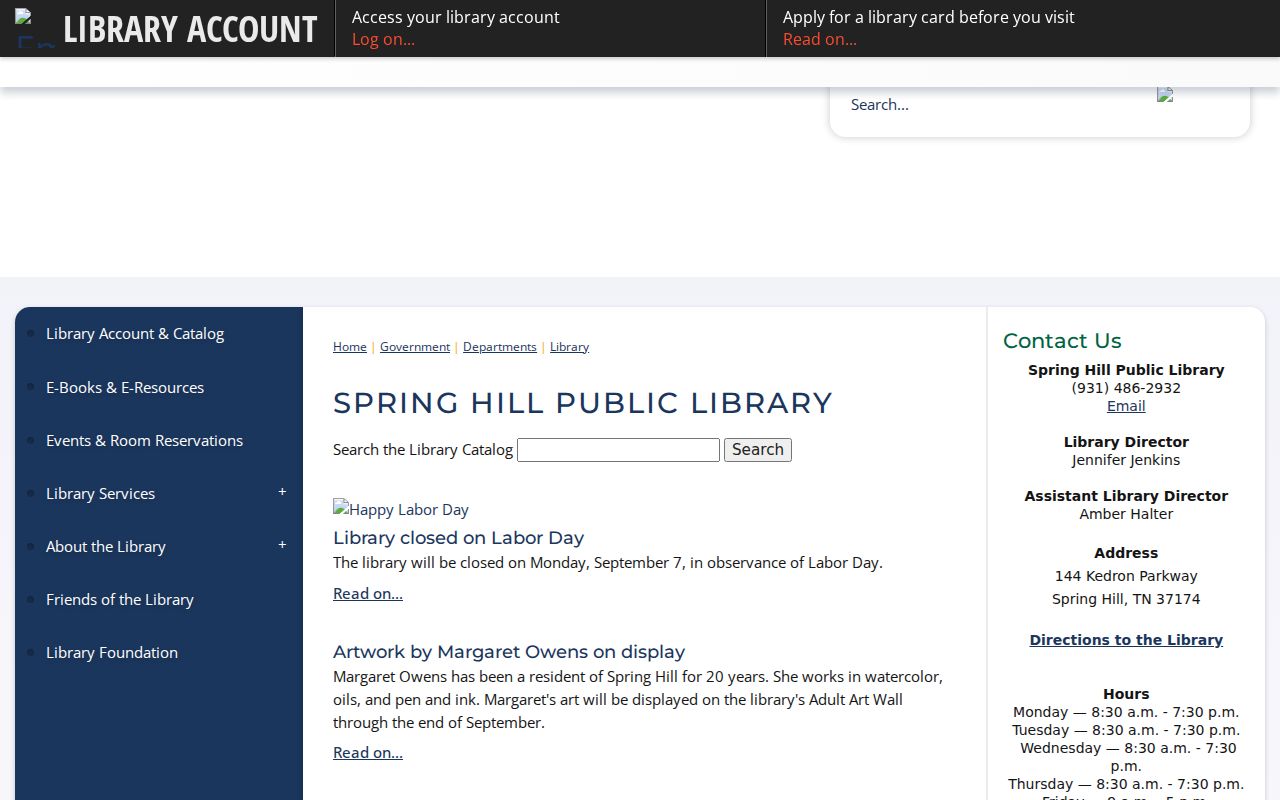
Use a library database result as a lead, then retain the publication date and source title. It is not a substitute for the archive item, a county instrument, or a certified record.
Decode a Spring Hill City Directory Entry
No publicly viewable Spring Hill directory page was found, so there is no safe generic sample entry to reproduce. When a page is located, record only what the volume actually prints: name, spouse or household notation, address, occupation or employer line if present, owner or occupant mark if present, widow notation, telephone number, and the volume's abbreviation key. Some volumes omit several of those fields. A name at an address is a dated entry, not proof of a current household.
| Volume identity | Title, year, publisher, page number, and scan or shelf reference |
|---|---|
| Name line | Spelling, initials, suffixes, married-name form, and any printed household notation |
| Place line | Street address, lot or legal-description reference, and whether the item has a reverse entry |
| Context fields | Only the occupation, telephone, owner mark, or widow notation actually printed |
| Evidence state | Index lead, inspected page, microfilm reference, or copy requested |
- Criss-cross directory
- An address-ordered directory that can connect a house number and street to the printed occupant for that volume year.
- Householder index
- An index arranged around the person or household named in the publication, not a claim about everyone living there.
- Abbreviation key
- The volume’s own explanation of shortened words or marks. Photograph or transcribe it before interpreting an entry.
Spring Hill City Records Beside Volumes
Municipal files can support a dated address or local-history question without becoming a people directory. The Spring Hill City Recorder is the custodian route for existing municipal records, ordinances, resolutions, and public-record requests. City records of interest can include cemetery deed books and interment records, planning and subdivision material, permits, inspections, code files, and meeting records. Each system has its own access limits and should not be joined into a single personal profile.
A request should identify an existing record type, subject or address, timeframe, department, and useful keywords. The city form offers inspection or copy choices and asks the requester to set delivery and estimate preferences. The city describes a typical 72-hour completion target, while Tennessee public-record timing and exemptions still control the response. Do not request a newly compiled historical directory when an existing file, ledger, index, or minute record is the real need.
The City Recorder request entry point is shown here for a Spring Hill historical-research fallback.
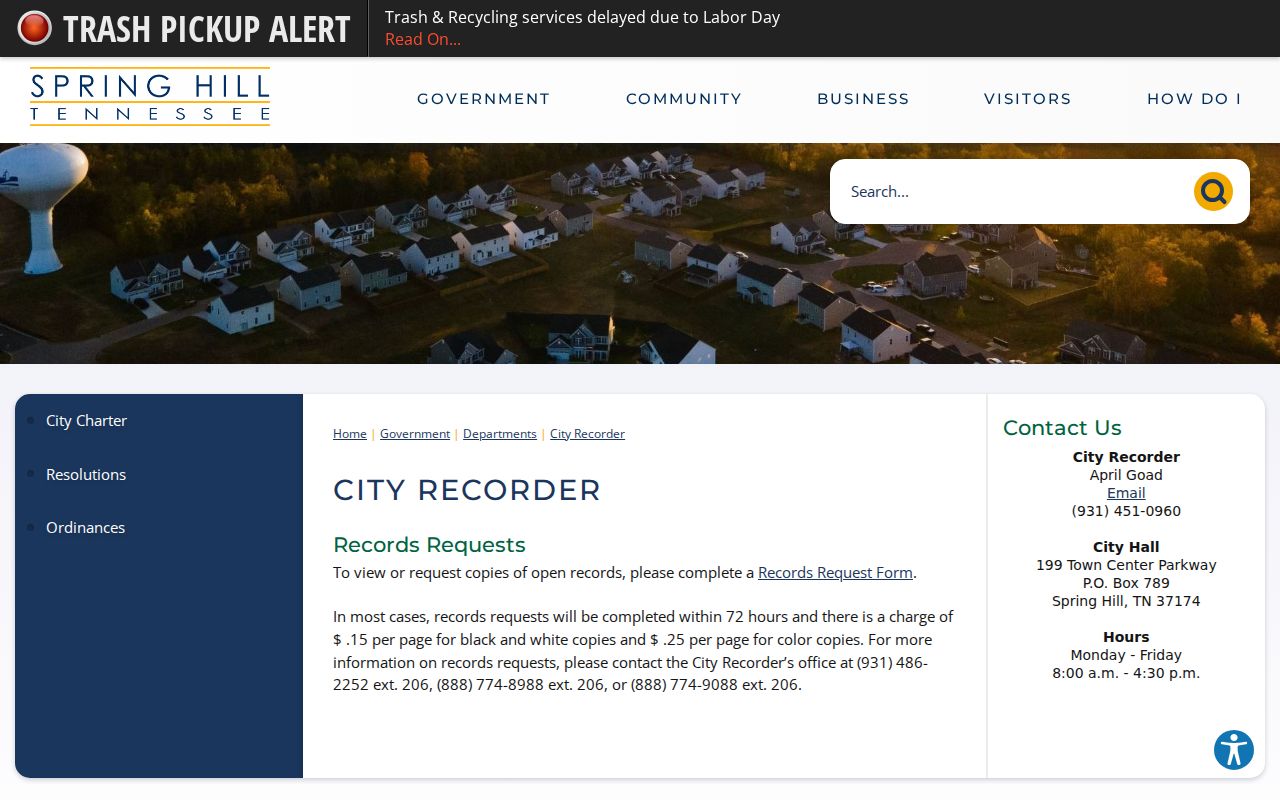
The capture shows the municipal access route, not a searchable list of residents. A request may yield redacted portions or require a county, date range, and record-specific follow-up.
Note: A municipal address record can support a dated event, but it does not establish a full household or ownership history.
Spring Hill Records Clues and Documents
Williamson Archives reports more than 405,000 indexed entries in groups that include deeds, marriages, courts, probate, taxes, burials, obituaries, ordinary licenses, and wills. Its coverage is group-specific: marriages reach 1803-1987, while court, deed, and obituary ranges differ. The archive reading room is at 611 W Main St in Franklin; copies can be requested by phone or email after a researcher has captured a useful reference. The practical sequence is search, record the reference, inspect the cited medium, then describe the result by its source and date.
On the Maury side, the TSLA Maury fact sheet lists direct and reverse deed-index microfilm from 1807-1905, marriages from 1808, wills from 1807, estate settlements, tax books, newspapers, and WPA family, Bible, tombstone, and church material. The state’s county microfilm inventory can help when a local library does not hold the needed reel. FamilySearch collections for Tennessee marriages and probate may supply an index or image lead, but the archive or court custodian controls the underlying county record.
The documented record trail has several useful date markers:
- 1807: Maury County minutes and wills begin in the TSLA fact sheet.
- 1808: Maury marriage records and deed-index series begin in that state reference.
- 1899 onward: Maury-area newspaper coverage is described as more complete than the scattered 1810s material.
- 1994: a tri-city directory appears as an unverified secondary discovery lead.
- March 2026: Williamson Archives received a scanner appropriation, without a promise that any specific item is online.
For current address-keyed evidence, the Spring Hill Street Directory follows the assessor and deed path instead of rebuilding the historical shelf.
Trace Spring Hill Households in Volumes
Start with a confirmed name or address and make one row of notes for each dated finding. Consecutive directory years can reveal spelling changes or moves, but a gap can mean a different county, an unlisted person, a publication gap, or a changed street reference. Pair a directory year with census material released under the federal schedule, a deed instrument, newspaper notice, obituary, probate file, or city cemetery record. The combination is stronger than any single entry.
- Identify the county and preserve the name exactly as printed, including initials and suffixes.
- Ask the relevant library or collection for a dated volume and any reverse-directory section.
- Record the page, address form, household notation, abbreviation key, and whether the page was inspected.
- Compare the next available directory or newspaper year, then keep the source dates side by side.
- Use deeds, probate, obituaries, or cemetery records to test a move, death, or ownership change.
Directory appearances and disappearances need corroboration. An entry may reflect the publisher’s cutoff date rather than a move date. A deed identifies a transfer party and legal description, while a census or obituary supplies a different kind of household evidence.
Spring Hill Collection Gaps
The main limitation is transparent: no official Spring Hill Polk, reverse, criss-cross, telephone-book, or other printed-directory run list was found. The 1994 tri-city reference is useful for discovery, but its publisher and scan remain unverified. The Library of Congress Sanborn record located for this research is a December 1895 Columbia map with 12 sheets, not a Spring Hill map, and should not be substituted for a Spring Hill address.
Older address work often needs the legal description, deed book and page or instrument number, parcel identifier, and county rather than a modern street name. Keep the original spelling alongside any normalized form. An archive database can contain a future-looking or anomalous metadata value, including Williamson's displayed 2062 obituary value, so read a coverage display as an index label to verify, not an automatic historical fact.
Note: A failed search can reflect a missing scan, a different county, a spelling variant, restricted access, or incomplete coverage rather than an absent person or address.
Spring Hill Archive Record Access
Williamson Archives received a March 2026 scanner appropriation, a preservation milestone that may improve future access. It does not mean that a requested directory, deed book, or file is already digitized. For now, the documented alternatives remain the online index, in-person reading room, phone or email copy route, county books, library databases, and TSLA microfilm. A later check may be worthwhile after an item has first been identified by its exact reference.
The Spring Hill Historical & Genealogical Society also resumed public gatherings in 2025 after a long hiatus, with reporting that meetings were commonly held at the library. Verify dates with the library or society before traveling. Its return is a community research lead, not proof of a directory collection or a public surname roster.