
Spring Hill Previous Residents by Era
Earlier household research requires different sources for different periods. The closest record may be an assessor snapshot, but it is not title proof or a statement that the owner occupied the house. Recorded instruments are the land-transfer trail. Historical directories, newspapers, census material, probate, and cemetery records can add a household layer. Spring Hill spans Maury and Williamson Counties, so begin every address file by recording the county and avoid treating a Spring Hill mailing label as jurisdiction proof.
| Source | Years It Covers | Where Held | What It Shows |
|---|---|---|---|
| Maury direct and reverse deed-index microfilm | 1807-1905 | TSLA and county-record routes | Grantor, grantee, book or reference leads for transfers |
| Williamson Archives deed references | Deed Books 1786, 1792-1963, 1977 | Online index and Franklin reading room | Record-group references to books, microfilm, or loose files |
| Tri-city directory discovery lead | 1994 | Secondary genealogy reference | Possible historical directory lead; scan and publisher unverified |
| Maury and Spring Hill newspapers | Scattered 1810s; more complete from 1899 | TSLA microfilm, library databases, county resources | Dated notices and name or address leads |
| Tennessee marriage and probate collections | Marriages 1790-1959; probate 1795-1955 | FamilySearch county and TSLA source material | Indexes and images where available, subject to collection access |
An address may also appear under a legal description, lot, subdivision, or older street form. Use the table as a routing tool, not as a claim that every item is online or complete. Note: Record the source, county, exact reference, date span, and whether the underlying document was inspected.
Spring Hill Records Need County Labels
The city crosses the Maury and Williamson line. A parcel in Spring Hill can therefore lead to a different recorder, assessor, election office, archive, and courthouse depending on its county. Columbia is Maury County’s seat and Franklin is Williamson County’s seat. The county must be resolved from a parcel or boundary source before a deed chain is searched, not guessed from the city name.
Postal labels add another trap. Some incorporated Spring Hill addresses use ZIP 37179, whose postal city is Thompson's Station, while 37174 is recognized as Spring Hill. City limits, postal city, and county describe different geographies. Preserve all three in the research notes. A result with a Thompson's Station postal label should be checked against the parcel and boundary evidence rather than discarded.
Records geography. Mark every Spring Hill result Maury or Williamson before connecting a name, transfer, household entry, or map reference to the address.
Follow Spring Hill Property Records Backward
Start with the current parcel record in the correct county and copy the property location, owner as shown for its displayed tax year, parcel identifier, subdivision or lot, and legal description. A situs address is the property location. The mailing address is where the assessor sends notices and may be elsewhere. Then locate the acquisition instrument in the Register of Deeds index. Search grantor and grantee separately, retain the recording date, document type, book and page or instrument number, and compare the legal description with the parcel.
The Maury County Register of Deeds is the official route for Maury instruments and public in-office viewing. Its official page points to TitleSearcher, where access and charges can differ from office viewing. Current online coverage was not stated in the reviewed material. The Williamson Register of Deeds directory gives the current office route, while the Williamson Archives index is the documented historical reference path. The underlying image or copy, not the index result alone, supplies the document to review.
The Maury Register of Deeds entry point is shown in this Spring Hill house-history research capture.
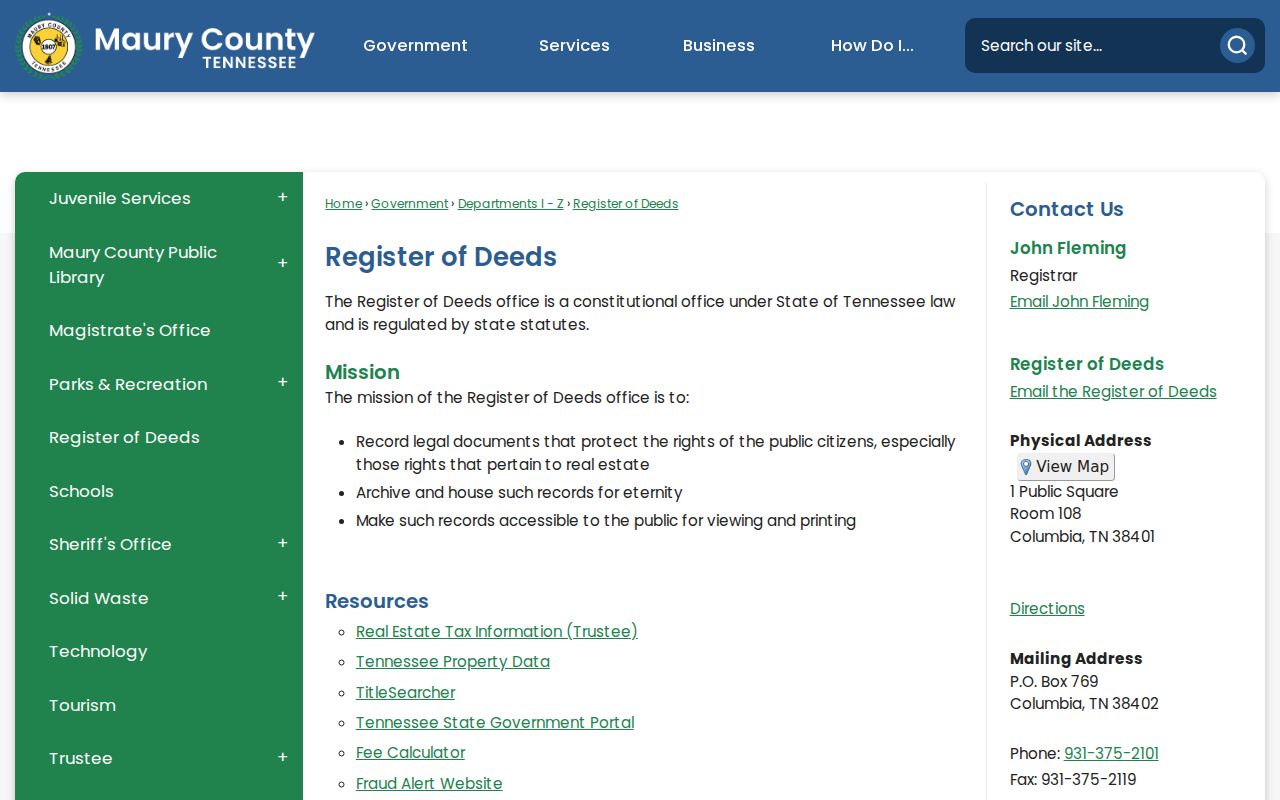
The capture identifies the county route. It does not show a live deed result and should not be read as proof of a transfer, a household, or current occupancy.
- Resolve the address to a county, parcel, lot, and legal description before opening a deed index.
- Find the present owner’s acquisition deed, where available, as the grantee on that transfer.
- Record the seller, who was the grantor on that deed, with the date and book/page or instrument number.
- Search that seller as a grantee to locate the earlier purchase, then repeat the comparison of legal descriptions.
- Move to the cited deed books, microfilm, or custodian copy route when the web index stops or lacks an image.
Spring Hill Archive Record References
Williamson Archives provides free Name, Keyword, and Field search tabs. Name search takes last and first name plus record-group choices. Keyword search can use all terms or any term, while field search works within a selected record group. References can lead to microfilm, a bound book, or a loose file. That distinction matters: an index lead and a reviewed record should be labeled as different evidence states.
The index covers more than 405,000 entries across deeds, marriages, court records, probate, taxes, burials, obituaries, ordinary licenses, and wills. Its individual date ranges are not interchangeable. Deed Books are listed as 1786, 1792-1963, and 1977, while marriages are listed 1803-1987. When a reference is found, capture the query, record group, indexed name, book, reel, or file reference, county, page or image availability, and access date before asking the reading room for a copy.
The Williamson Archives search screen is the official reference route illustrated here.
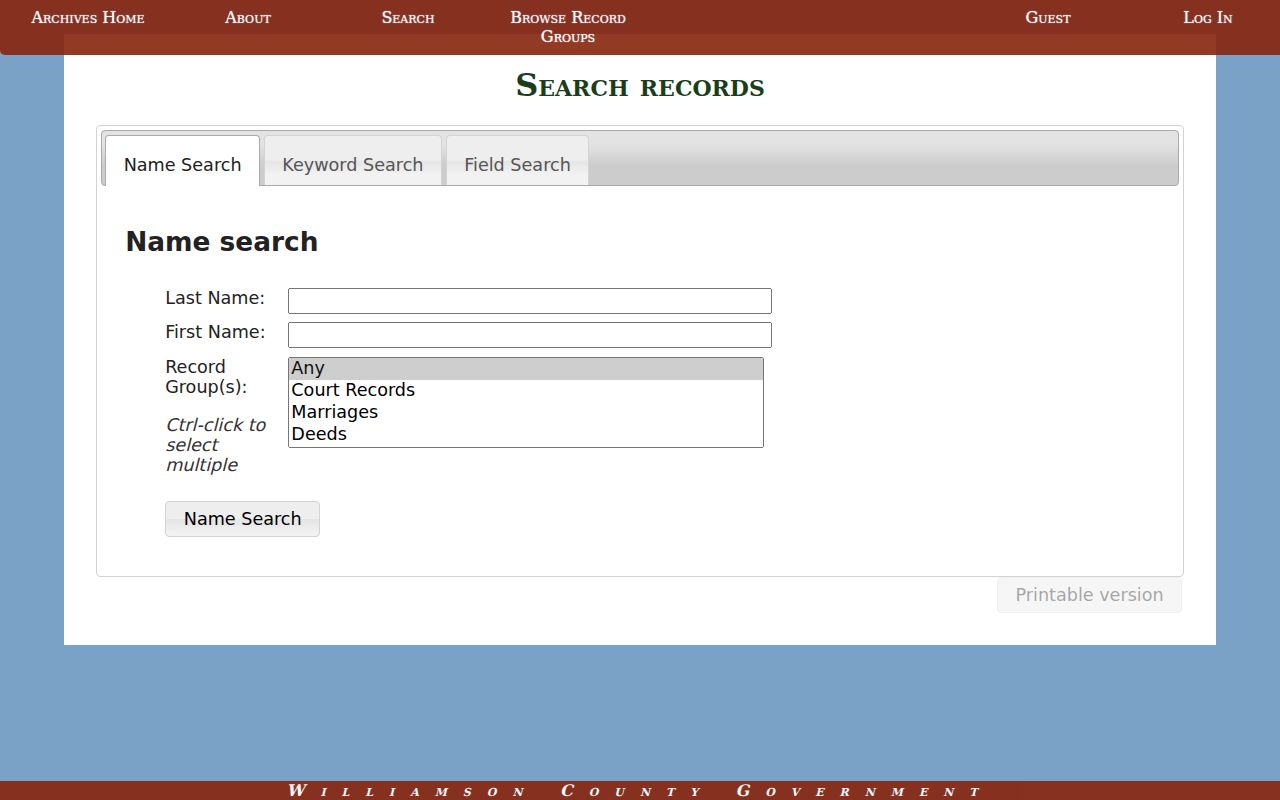
Follow the displayed reference to its cited material. Search controls and available digitized images can change, while the book, reel, or file reference makes the research repeatable.
Preserve Spring Hill Address Records
Modern addresses do not always survive unchanged in historical work. Research notes should preserve the exact source spelling as well as any USPS-normalized version. The durable keys are the county, parcel or control map-group-parcel identifier, subdivision and lot, legal description, document number, book and page, and recording date. A street number by itself can be weak when older documents use a tract description or an old road name.
- Grantor and grantee
- The grantor is the party conveying an interest in a recorded instrument. The grantee is the party receiving it. Search each role separately.
- Chain of title
- A dated sequence of recorded transfers tied to the same legal description, not simply a list of similar names at a street address.
- Legal description
- The lot, block, subdivision, metes-and-bounds, or other land description used in a recorded instrument. It can bridge older address forms.
- Index lead
- A search result that points to a source. It becomes reviewed evidence only after the cited book, reel, file, or image is checked.
Assessment data can include an owner, mailing address, property location, sale information, and tax-year context, but it is not a title opinion. A permit applicant, owner, mailing recipient, directory entry, and voter registrant are separate roles. Do not merge them into one claim about who lived at the property.
Note: Preserve both the source address and the legal description, because either one may be the only usable bridge to an older record.
Spring Hill Directory Leads for Households
Historical directories can add the household layer that deed records do not provide, but the exact Spring Hill printed runs have not been located. The 1994 Columbia, Mt. Pleasant and Spring Hill directory is a secondary discovery lead only. Its publisher and scan were not independently located. Williamson Special Collections in Franklin confirms a city-directory collection category and should be asked for years, reverse directories, and access conditions. The historical shelves themselves are described on the Spring Hill Directory Book.
Spring Hill Public Library at 144 Kedron Pkwy offers America’s News from NewsBank, Ancestry Library Edition, Fold3, FamilySearch affiliate access, and Tennessee Electronic Library resources. America’s News includes the Spring Hill Advertiser News and Columbia Daily Herald. Ancestry Library Edition is in-library, and other routes can require a card, an in-building session, or vendor authentication. Call 931-486-2932 to confirm conditions before relying on a trip for a specific issue or database.
The Spring Hill Public Library access point used for house-history research appears below.
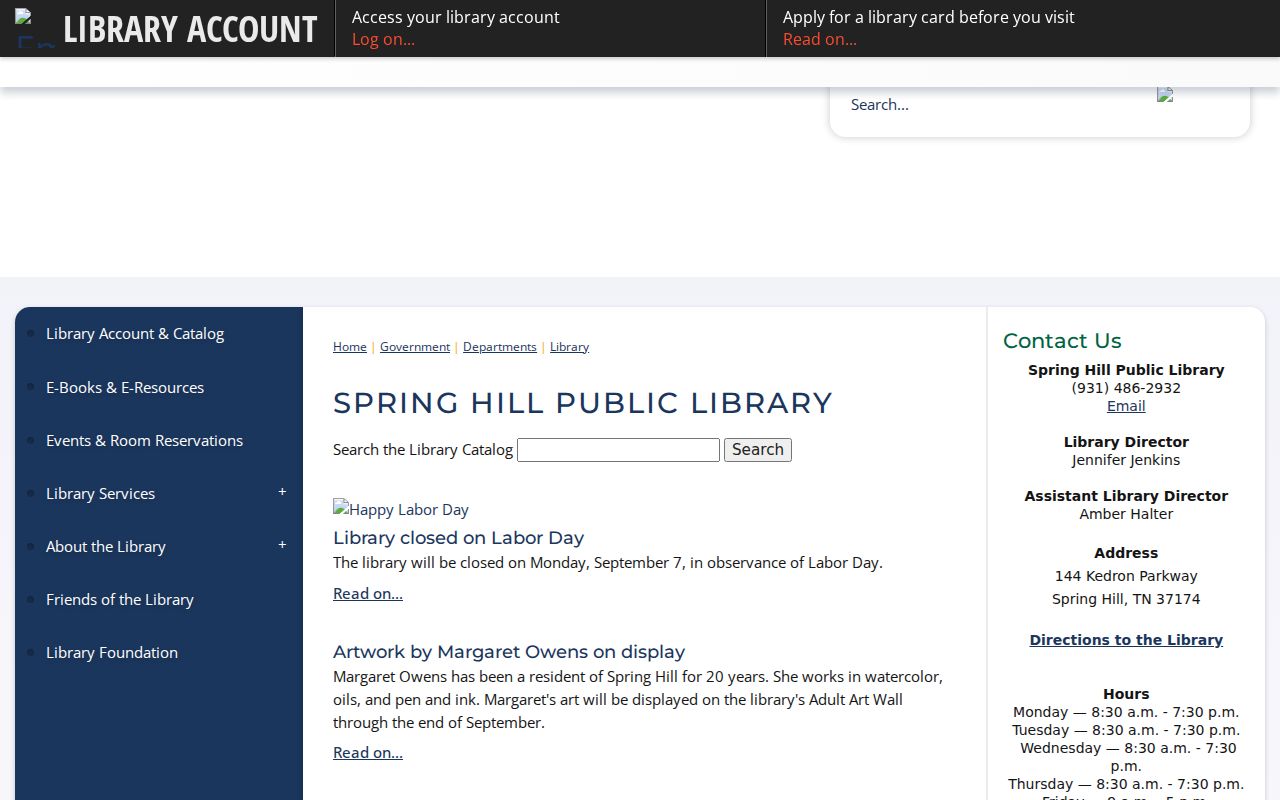
A library result is a dated research lead. Pair it with a deed, archive item, census record, obituary, or other source before treating it as a household conclusion.
Digital Tennessee's Williamson collection is another route to browse county material, books, microfilm, and scans. The reviewed source did not locate a digitized Spring Hill directory scan.
The collection gateway can help identify a reference, but it does not turn an unverified directory lead into an inspected volume.
Pair Spring Hill Household Records
Ownership is only part of a house history. Use a directory or newspaper lead to identify a possible household, then pair it with census material released under the federal schedule, an obituary, probate, marriage index, or city cemetery request. Federal census access is governed by the 72-year release rule. It is useful for dated household research, but it should not be forced to match a modern address when an older source uses a legal description or a changed street form.
Address and household research can be recorded as a simple evidence flow:
- Address as written in the source, plus the current normalized form and county.
- Parcel and legal description, then the deed chain with grantor and grantee roles.
- Directory, newspaper, or archive name lead for a specific year.
- Census release-year material or another dated household source.
- Obituary, probate, or cemetery record as a later-life or estate endpoint when relevant.
A missing directory entry does not prove that a person left, died, or never lived there. It can reflect a publication gap, spelling variation, a different county, unlisted status, restricted access, or a source that has not been digitized.
Spring Hill Records at Trail End
For a deceased former resident or an estate question, keep the record types separate. The TSLA Maury fact sheet identifies wills from 1807, estate settlements 1853-1889, and related WPA family, Bible, tombstone, and church material. FamilySearch’s Tennessee probate collection covers wills, inventories, settlements, guardianships, bonds, divorce, and related county files from 1795-1955 where accessible. The archive, clerk, or court remains the authority for the original county file.
Newspaper research can add dates and names. Maury, Spring Hill, and Mt. Pleasant titles are scattered in the 1810s and more complete from 1899 onward, with access through TSLA microfilm, county resources, and library databases. City cemetery deed books and interment records are permanent city records, but no public searchable interment database was found. Request an existing record through the City Recorder rather than asking for a newly compiled list.
Note: Keep an obituary, probate, cemetery, and deed finding in separate fields until their dates, counties, and underlying documents support the same person or property conclusion.
Lawful Spring Hill House History
Spring Hill house-history research fits family history, heir work, and personal curiosity. It does not justify tracking or harassing a living person. Do not publish or retain unnecessary personal phone numbers, full birth dates, protected addresses, financial information, minor information, medical details, victim identifiers, or access credentials. Tennessee’s Safe at Home program can supply substitute addresses for qualifying participants, and other confidential fields may be redacted.
Lawful use. Use public records to understand an address or family history, respect redactions and protected addresses, and never use a Spring Hill record to stalk, harass, or harm anyone.
For a record that may contain exempt material, ask the custodian for the non-exempt portions and the statutory basis for each redaction or withholding. A public-record request should name the existing record type, address or parcel, date range, department, and useful keywords. It should not ask an office to create a new profile or list.